
What's the Best Position in Your Garden for an Outdoor Kitchen?
Where you put your outdoor kitchen matters more than most people realise. It affects how much you use it, how comfortable it is to cook in, how your guests experience the space, and how the whole garden flows. Get the positioning right and everything else is easier. Get it wrong and you'll know it within the first summer.
This is a question we spend real time on with every client. There's no single correct answer; it depends on the garden, the house, the way the family lives, and the practical constraints of gas, water, and electricity. But there are principles that apply almost everywhere, and there are mistakes we see made repeatedly.
Here's how to think about it properly.
The Most Common Positioning Mistake: Ignoring Where the Sun Goes
People choose a position that looks good on a plan or feels instinctively right when they're standing in the garden. They pick the spot that seems like the natural "cooking area." Then they build the kitchen, have their first summer with it and realise that the kitchen is in direct full sun from 1pm to 7pm, which is exactly when they want to be cooking.
Sun is one of the most critical factors in outdoor kitchen positioning, and it's consistently one of the least thought-through.
The ideal scenario for most UK gardens: morning sun to make early use pleasant, shade (natural or structural) during the hottest afternoon hours, and ideally a position that catches the evening sun as it comes around, since evenings are when most people actually use their outdoor kitchen.
Track the sun in your garden across a full day before committing to a position. If you can, do it at the height of summer, when the sun arc is at its widest. Where is full shade at 3pm? Where does the evening sun reach? A south-west or west-facing aspect is often optimal in the UK; you get evening light without the full intensity of the afternoon sun.
Proximity to the House: Convenience vs. Independence
How far from the house should your outdoor kitchen be? There are two schools of thought, and both have merit.
Close to the house makes sense for practical reasons: shorter runs of gas pipework, electricity, and water. Carrying food and equipment from the kitchen is less of a journey. For families with young children, being able to see into the house from the cooking area matters. In UK winters, you're not walking across a cold, wet garden to get to the kitchen.
Further from the house gives you more design freedom and a greater sense of destination. The outdoor kitchen becomes a place you go to, rather than an extension of the back door. It can anchor a larger garden space more effectively.
Our general guidance: for most gardens, within eight to twelve metres of the house is practical. Beyond fifteen metres starts to create friction in everyday use. But the right answer depends on your garden's specific layout and your lifestyle: a couple who entertain extensively may happily walk further; a family with young children rarely will.
One critical practical point: if you need gas, the run of pipework from the house to the kitchen has to be within a buildable distance, and it has to be done by a Gas Safe registered engineer. The further the kitchen is, the longer the run, and the more costly. Worth factoring in early.
Wind Direction: The Factor People Forget Until It's Too Late
A south-west-facing outdoor kitchen sounds ideal: good evening light, sensible orientation. But south-west is also the direction from which the UK's prevailing winds arrive. If your garden is exposed, you could be cooking in a wind tunnel every time the weather gets interesting.
Before settling on a position, think about prevailing wind in your specific garden. Where does the wind come from? Are there existing trees, walls, or buildings that provide shelter? Is there a direction that's naturally more sheltered?
Wind affects outdoor cooking in two key ways: it makes the cooking area uncomfortable, and it creates downdraft issues for gas appliances, which can affect how reliably the grill lights and maintains temperature. If wind is a factor in your garden, a covered structure (a bioclimatic pergola with side panels or zip screens) can make an otherwise exposed position very comfortable.
The Role of an L-Shaped or Island Layout in Positioning
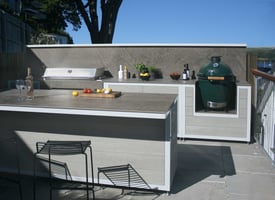
The shape of your outdoor kitchen interacts with its position. An L-shaped outdoor kitchen positioned in a corner of the garden creates a natural enclosure that defines the cooking and dining zone. An island or linear kitchen positioned centrally allows cooking to face multiple directions, useful for social cooking where the chef wants to face guests rather than a wall.
Positioning and layout are closely linked decisions. When we work with clients on outdoor kitchen design, we never finalise the layout without first understanding the position, and vice versa.
Sight Lines, Privacy, and Social Flow
Think about where guests will naturally stand or sit when you're cooking. If the cooking area faces a fence or a wall, the chef has their back to the party. If it faces the garden and the dining area, they're part of the conversation. One of these is a significantly better social experience.
Privacy is also worth considering, particularly if you're in a terrace, a closely developed area, or a garden that's overlooked. An outdoor kitchen in a position that feels surveilled is one that gets used less. A position that feels like your own space encourages relaxed use.
Integration with a Pergola or Cover
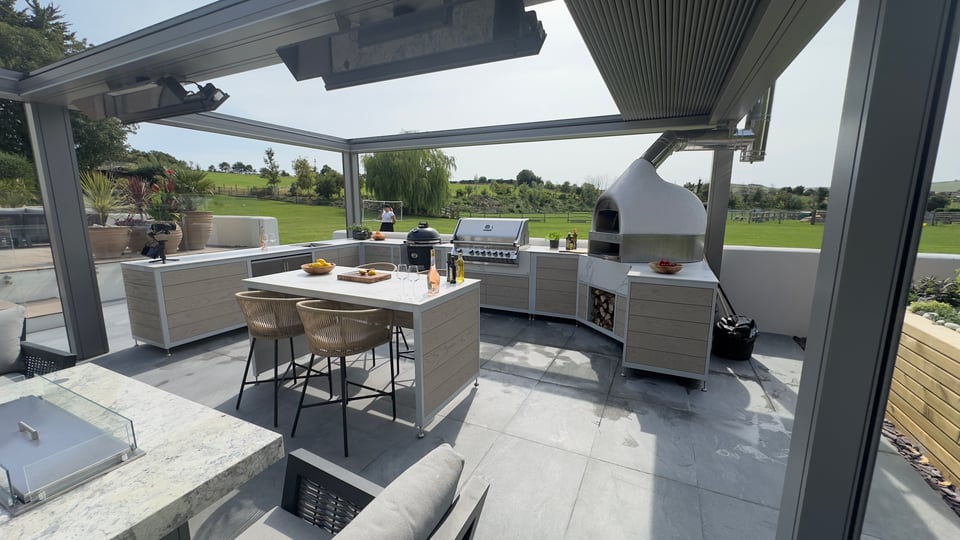
If you're planning a covered outdoor kitchen (we'd strongly recommend it for year-round use in the UK climate), the position of the kitchen and the position of the pergola structure are essentially the same decision.
A bioclimatic pergola with a louvred roof creates a flexible microclimate: open the louvres for sun, close them for shade or rain, add side panels for wind protection. This gives you significantly more freedom on positioning, because you can manage the sun, shade, and wind conditions yourself. A well-sited outdoor kitchen under a covered structure can work in almost any garden aspect.
The one critical technical requirement: the pergola structure needs a surface to drain to. Rainwater from a louvred roof has to go somewhere, typically into gutters and away via drainage. This needs to be planned for from the start, not retrofitted.
Practical Constraints That Must Come First
Before any aesthetic or lifestyle considerations, there are hard practical constraints on outdoor kitchen positioning:
Services. Gas, electricity, and water all have to reach the kitchen somehow. The position needs to allow for sensible routing of these services, typically via the house or an outbuilding. A position that requires crossing the entire garden, under established paving, with a water supply is going to be expensive to service.
Drainage. Water from a sink needs to drain. Depending on local regulations and site conditions, this may mean connecting to the main drainage run or to a soakaway. Get advice from a drainage specialist before committing to a position if there's any ambiguity.
Level ground. An outdoor kitchen needs a solid, level base. Sloping gardens can be dealt with, but the groundworks cost increases significantly if the kitchen position requires significant levelling.
Access. Your installation team (and any subsequent maintenance or repair work) needs to be able to access the kitchen position with equipment. A spot that's only reachable via a narrow side passage adds installation cost and operational complexity.
Our Approach at Barbacoa
Every Barbacoa project starts with a site visit before we put pen to paper on a design. We visit the garden, spend time in it, and talk to the client about how they live: when they use the outdoor space, whether they entertain, how much time they spend outside on weekday evenings versus weekend afternoons.
Only after that do we discuss where the kitchen should go. Sometimes what the client had in mind is exactly right. More often, the site visit reveals something that shifts the position, sometimes slightly, sometimes significantly. Getting this right at the start is the single best investment of time in any project.
If you're planning an outdoor kitchen and want to talk through positioning for your specific garden, book a free consultation. We can often spot opportunities and constraints in a twenty-minute conversation that would take months to discover through trial and error.